Introduction: AI's Environmental Impact
Artificial intelligence is often perceived as a technology of the virtual world, an immaterial force that exists "in the cloud." This perception, however, obscures a profound reality: the digital revolution has a massive and often hidden physical footprint. Behind every query and every trained model are data centers that consume vast amounts of energy, water, and materials.
This article reveals five of the most surprising and impactful environmental truths about artificial intelligence. Based on recent data and analysis, these points uncover the tangible costs of our increasingly digital lives, from the water drawn from local reservoirs to the mountains of electronic waste left behind.
AI is Thirstier Than You ThinkAI is Thirstier Than You Think
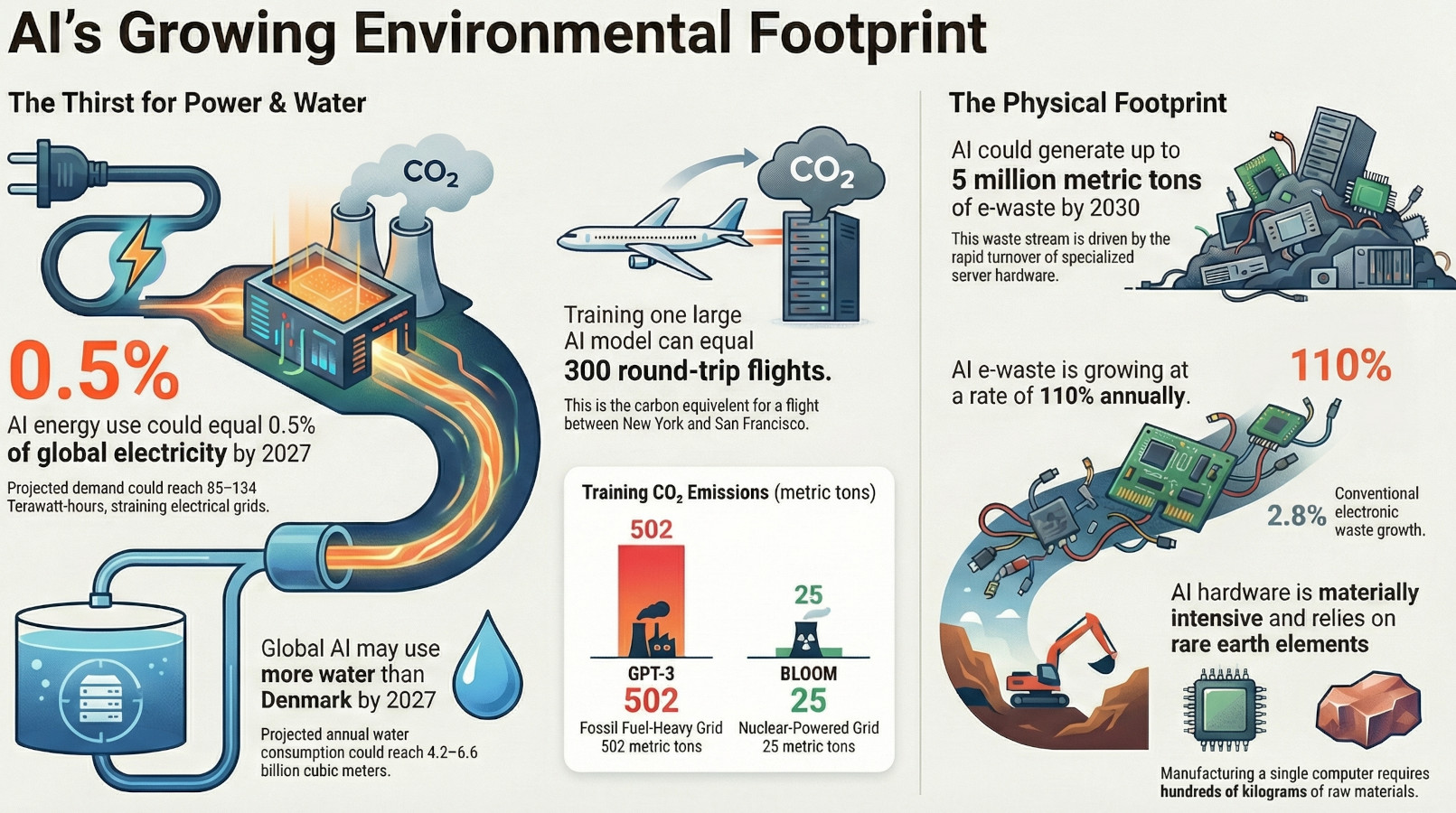
Data centers, the engines of the AI revolution, require enormous amounts of water for cooling. The scale of this consumption is staggering. By 2027, global AI demand is projected to consume between 4.2 and 6.6 billion cubic meters of water—an amount four to six times greater than the entire annual water withdrawal of Denmark.
Even on a micro level, the impact is tangible. A single text query to Google's Gemini model uses about 0.26 milliliters of water, equivalent to five drops. While small on its own, this adds up across billions of interactions. This hidden dependency on a critical natural resource highlights the immense strain AI places on local water supplies, particularly in drought-prone regions where data centers are often located.
The Digital Revolution Creates Mountains of Physical Waste
AI's insatiable demand for computational power forces a rapid and relentless cycle of hardware upgrades, turning state-of-the-art GPUs and servers into a fast-growing stream of electronic waste (e-waste). This accelerated turnover is driven by rapid technological advancements, the need for constant upgrades to maintain performance, operational cost savings, and even geopolitical constraints on supply chains. Projections indicate that generative AI is expected to generate between 1.2 and 5 million metric tons of e-waste by 2030, which could account for up to 12% of the global total.
The compound annual growth rate for AI-related e-waste is 110%, far outpacing the 2.8% growth from conventional electronics like smartphones. This shatters the illusion of a "clean" digital economy and exposes the full lifecycle cost of AI hardware—from the environmental impact of resource extraction to the challenges of disposing of toxic materials safely.
The Carbon Cost is Hidden in Every Query
The immense energy required to train and run AI models often comes from fossil-fuel-reliant power grids, creating a significant carbon footprint. The scale of this energy use is difficult to comprehend in the abstract, but a concrete example brings it into focus: training the GPT-3 model released 552 metric tons of carbon dioxide. This is equivalent to the lifetime emissions of nearly five average cars or 300 round-trip flights between New York and San Francisco.
However, this impact is not inherent to the technology itself but is a direct consequence of the energy source. In a stark contrast, Hugging Face’s BLOOM model, comparable in size to GPT-3, was trained on a French grid powered largely by nuclear energy and emitted only 25 metric tons of CO₂. At the user level, the impact is also clear. A single ChatGPT query uses five to ten times more electricity than a traditional Google search. As Noman Bashir of MIT notes, this relentless growth creates a fundamental challenge for sustainable development: “the demand for new data centers cannot be met in a sustainable way.”
The Environmental Burden Isn't Shared Equally
The environmental costs of AI are not evenly distributed around the globe. This creates a stark "environmental inequity." In 2022, for example, Google's data centers in Finland operated on 97% carbon-free energy, while its centers in parts of Asia used only 4–18% carbon-free energy.
The consequences are profound. Communities in regions with carbon-intensive grids or in water-stressed areas like Arizona bear a disproportionate burden of air pollution and resource depletion. This adds a critical layer of social and environmental justice to the conversation. In fact, critics have drawn comparisons to historical patterns of environmental injustice, likening the practice of siting resource-intensive data centers in marginalized regions to settler colonialism and racial capitalism, forcing a consideration of who benefits from the AI revolution versus who pays the environmental price.
Efficiency Is Soaring, But Our Demand Is Soaring Faster
There is a counter-intuitive paradox at the heart of AI's environmental impact. On one hand, efficiency is improving at an incredible rate. Google, for instance, reported a massive 44x reduction in the carbon footprint per Gemini text prompt over just 12 months.
Yet, this is only half the story. In the race between efficiency and demand, demand is winning. Despite these incredible efficiency gains, the overall environmental impact of major tech companies is still growing. Google, Microsoft, and Meta all reported significant increases in their carbon footprints due to the exponential growth in demand for AI workloads. This shows that technological efficiency alone isn't enough to solve the problem; the explosive growth in AI usage is currently outpacing any gains, leading to a net increase in resource consumption.
Conclusion: A Smarter Path Forward
AI presents a dual role in our planet's future. It is a major environmental challenge, driven by an insatiable appetite for energy, water, and materials. At the same time, it holds the potential to be part of the solution. This path forward requires a combination of smart regulation, like the EU's AI Act which mandates resource reporting, and innovative technologies like geographical load balancing that route workloads to regions with the cleanest energy.
The true test of artificial intelligence will not just be in how it reshapes our world, but in whether we can build this powerful future without undermining the planet that sustains us. As we race toward smarter machines, are we choosing a sustainable path?