5 Shocking Truths About AI Surveillance
That Are Already a Reality 
Audio Podcast
Audio Podcast - Comprehensive
Slide Deck - The Digital AI Privacy & Governance
Documentation
AI Privacy and Surveillance - Thesis
Concept Explainer
Topic Overview
Policy Proposal
Risk Assessment
Introduction: More Than Just an Assistant
When we think of artificial intelligence, we often picture helpful digital assistants, creative image generators, or tools that make our work easier. This consumer-facing view of AI, while accurate, dangerously obscures its most profound impact. A far less visible but more powerful application of AI is in the realm of surveillance, where its ability to collect, analyze, and interpret vast amounts of personal data is eroding fundamental rights and creating a fundamental challenge to democratic principles.
While AI can be used to enhance data protection, its most prominent role has been to enable pervasive surveillance on a global scale. This is not a distant, dystopian future; it is a present-day reality. Based on insights from the "CADO: Cybercrime, Agendas and Darker Objectives" report, this article uncovers five of the most significant and shocking ways AI-powered surveillance is already reshaping our world, from our workplaces to our systems of justice.
"Surveillance Capitalism" Knows You Better Than Your Friends
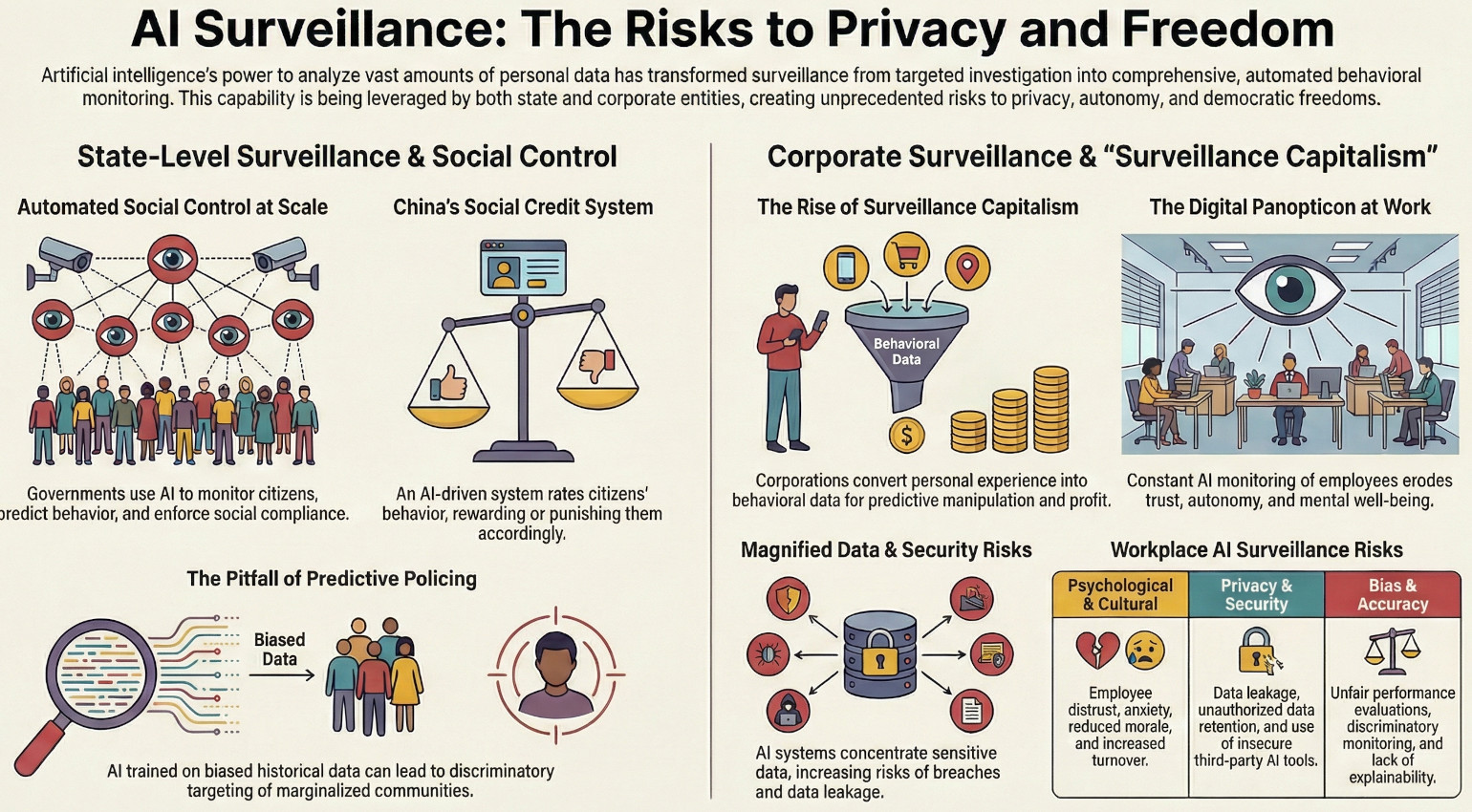
A powerful economic model known as "surveillance capitalism" now drives a significant portion of the digital economy. In this model, corporations convert human experience into behavioral data, which is then used for predictive manipulation. Data brokers collect thousands of data points on individuals from websites, apps, and smart devices, building profiles so detailed and accurate that they can know us "as well as close friends."
This data isn't just used for harmless personalization. It fuels sophisticated systems for targeted advertising, dynamic pricing strategies that can alter insurance premiums based on your tracked driving habits, and even large-scale political manipulation, as infamously demonstrated in the Cambridge Analytica scandal. The result is that corporate surveillance networks now rival the capabilities of governments. This entire economic model is built on a foundation of obscured consent, where complex legal agreements and opaque platform designs effectively strip users of any meaningful choice.
The Digital Panopticon Is Your New Office and Classroom
The profit-driven logic of surveillance capitalism is no longer confined to the consumer sphere; it is now being systematically applied to manage labor in environments where people have little to no ability to opt out. Employers now deploy systems that track computer usage, scan emails, and analyze keystroke patterns to infer the emotional states of their employees. These tools extend to deeply intrusive practices, such as AI in call centers that automatically grade employees based on script adherence or software designed to flag the use of words like 'union' in internal communications.
This constant monitoring creates a profound psychological impact. This constant scrutiny can leave employees feeling, in the words of one study, as if they are perpetually "under a microscope," a condition that undermines both autonomy and dignity. The concern extends to education, where AI is used to monitor student engagement through facial expression analysis and attention tracking during online learning. This practice raises serious questions about normalizing pervasive surveillance from a young age and infringing on the cognitive freedom of vulnerable populations.
Predictive Policing Isn't Predicting the Future; It's Reinforcing the Past
AI-powered predictive policing is presented as a futuristic tool to make law enforcement more efficient. These systems use historical crime data to forecast where and when future crimes are likely to happen, allowing police to allocate resources proactively. However, this isn't a theoretical problem—real-world systems like the "Strategic Subject List (SSL) used by the Chicago Police Department" and a similar system implemented by "Kent Police in England" have demonstrated a fundamental, counter-intuitive flaw: these systems risk amplifying and perpetuating existing biases.
If a marginalized community has been historically over-policed, the crime data from that area will be disproportionately high. An AI trained on this biased data will logically conclude that the area needs even more police attention. This creates a discriminatory feedback loop where the system reinforces the very biases it was fed, leading to further over-policing of the same communities. The NAACP has warned that these systems can worsen racial disparities in policing. Compounding the issue is the "black box" problem, where the proprietary algorithms are kept secret, making public accountability and oversight nearly impossible.
The Illusion of AI Can Be More Powerful Than the Technology Itself
In modern surveillance, the belief that one is constantly being watched is often enough to induce self-censorship and conformity. This is known as the panopticon effect. The actual capabilities of the surveillance AI can be less important than the public's perception of its power. Researcher Jathan Sadowski calls this "Potemkin AI"—systems designed to appear far more intelligent and effective than they truly are.
A striking example of this comes from Chinese state media, which frequently publicizes exaggerated or even fabricated success stories of its facial recognition technology. By promoting the idea that the technology is infallible, the state cultivates a powerful public belief in its own omnipotence. This perception becomes a potent tool for social control, deterring dissent and enforcing conformity regardless of whether every citizen is actively being monitored at all times. The illusion of technological power can be as effective as the power itself.
Social Control Is the Ultimate Goal
In state-level applications, the objective of AI surveillance moves beyond preventing crime and toward enabling widespread social control. China’s evolving social credit system is the most prominent example, built upon a staggering infrastructure that integrates over 600 million CCTV cameras with real-time facial recognition and gait analysis technologies.
This system doesn't just watch; it judges. AI algorithms autonomously detect "suspicious" behavior, flag dissenting speech online, and assign risk scores to individuals. Infractions that can lower a person's score include common offenses like jaywalking but also extend to posting critical comments online or associating with blacklisted individuals. The real-world consequences are severe: a low score can trigger automated disciplinary measures, including restricted access to loans, prohibitions on using high-speed rail, and other social penalties. This model represents a fundamental shift toward "proactive governance," where algorithms are used not just to react to wrongdoing but to actively enforce compliance and shape societal behavior on a massive scale.
Conclusion: Drawing the Line in a Watched World
As these five truths illustrate, AI-powered surveillance is not a theoretical threat looming on the horizon. It is a present-day reality with profound and immediate consequences for individual autonomy, societal fairness, and democratic freedoms. From corporate data harvesting to state-level social engineering, these systems are fundamentally altering the balance of power between individuals and the institutions that govern them, eroding civil liberties in the process.
The unchecked advancement of these technologies presents a grave danger. As automated enforcement lowers the cost of repression, it enables a more efficient and insidious form of control that threatens the very foundations of a free society. This leaves us with a critical question that demands urgent attention from citizens, policymakers, and technologists alike: as these powerful tools become inextricably woven into the fabric of our world, how will we defend our fundamental rights against the chilling efficiency of the algorithm?