Palantir's Secret World:
4 Shocking Truths About the AI Giant 
Audio Podcast
Audio Podcast - Comprehensive
Slide Deck - Palantir: The Architecture of Control
Documentation
Palantir Technologies - Thesis
Explanitory Article
Policy Brief
Palantir Strategic Analysis
Introduction: Palantir Technologies
Palantir Technologies exists in the public consciousness as a powerful but shadowy force. Part Wall Street darling, part CIA-funded intelligence powerhouse, its name is synonymous with the cutting edge of AI, national security, and big data. The company has carefully cultivated an image of a patriotic innovator, building the digital architecture necessary to protect the West. But this polished facade conceals a pattern of deep-seated controversy that spans the globe, from protests on the streets of London over its NHS data contracts to accusations of racial bias in its own hiring practices.
What really goes on behind the company's carefully managed reputation? Beyond the press releases and stock market surges lies a complex and controversial operational history. When you peel back the layers of corporate-speak, you find a track record that is often at odds with its public-facing mission of ethical restraint and principled action.
This article pulls back the curtain to reveal four of the most surprising and impactful truths about Palantir’s operations. Drawn directly from public records, government documents, and investigative reporting, these takeaways paint a picture of a company whose power and practices demand closer scrutiny.
They Used Migrant Children as "Bait"
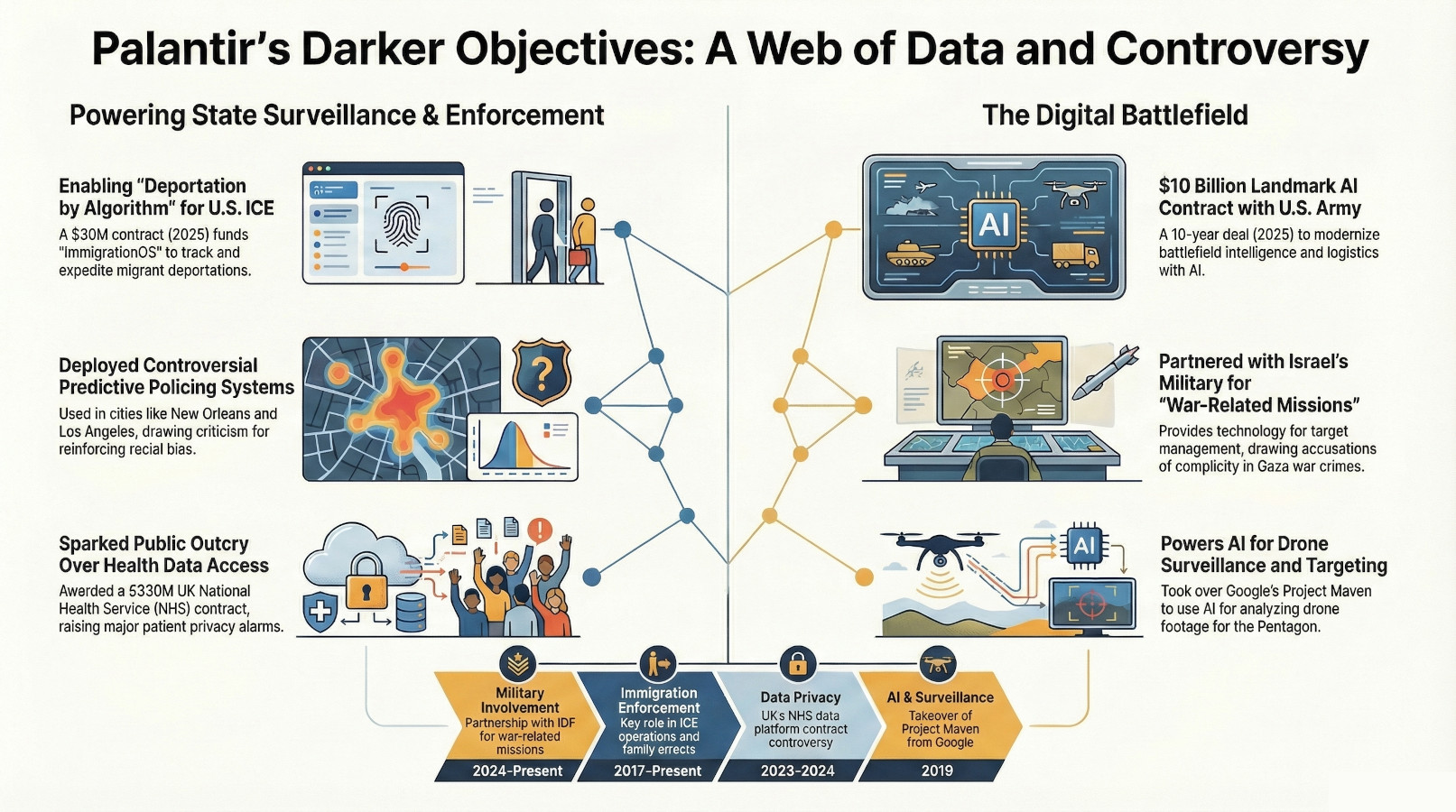
In 2017, U.S. Immigration and Customs Enforcement (ICE) launched a chillingly named operation: the “Unaccompanied Alien Children Human Smuggling Disruption Initiative.” This joint effort between ICE’s Homeland Security Investigations (HSI) and Enforcement and Removal Operations (ERO) divisions explicitly targeted the parents, sponsors, and relatives of unaccompanied minors who had crossed the border.
At the heart of this operation was Palantir’s Investigative Case Management (ICM) system. In practice, this meant every unaccompanied child became a potential lead. Their personal information, provided in a moment of vulnerability, was weaponized through Palantir's software to launch "collateral cases" into the very family members who came forward to care for them. Agents were directed to conduct database checks and, if they found anyone who was "out of status," to administratively arrest them.
The initiative's own numbers reveal its true purpose: of the 443 individuals arrested, only 35 ever faced criminal charges, with just 38 prosecutions ultimately resulting. Critics, including Amnesty International, have condemned the program, arguing that it effectively used vulnerable children as "bait" to entrap and deport their families, directly contributing to family separations. But Palantir's controversial reach extends from the border to the streets of America's biggest cities.
Their 'Minority Report' Policing Was Scrapped for Racial Bias
Palantir has been a key player in the controversial world of predictive policing, deploying its technology in major U.S. cities like New Orleans and Los Angeles. These programs were marketed as a high-tech solution to crime, using algorithms to identify individuals "likely" to be involved in future violence based on their social ties and arrest records.
But contrary to the narrative of infallible AI, these initiatives were not enduring successes. The Los Angeles Police Department’s predictive policing project was canceled in 2019 following a storm of public outcry and accusations that the system entrenched racial bias and demonstrably failed to reduce crime. This public rejection of Palantir’s technology in a major American city challenges the perception of AI as a neutral and effective tool in law enforcement.
The episode reveals a deep contradiction within the company itself. While stating Palantir doesn't currently build such tools, CEO Alex Karp conceded the company could do so "very well" and would be the "ideal" contractor for the task, an admission that highlights the company's latent capabilities and ambitions in this ethically fraught domain. This ambition finds its clearest expression not just in code, but in the company’s direct fusion with the state.
Their Top Executive is Now a U.S. Army Colonel
In June 2025, the lines between Silicon Valley and the Pentagon blurred in an unprecedented way. Palantir’s Chief Technology Officer, Shyam Sankar, was sworn in as a lieutenant colonel in the U.S. Army Reserve. He joined executives from Meta and OpenAI in a new, specialized unit called "Detachment 201," designed to bypass traditional military training and integrate tech leaders directly into advisory roles.
This move represents a strategic fusion of corporate tech power and state military apparatus. The explicit goal, as stated by Army Chief of Staff General Randy George, is to accelerate the Pentagon’s modernization because, “We need to go faster, and that’s exactly what we are doing here.” The significance of this integration cannot be overstated. This arrangement institutionalizes a conflict of interest, placing an executive with fiduciary duties to Palantir inside the military's strategic decision-making loop, ensuring the company's solutions are perceived as indispensable. For a company that builds the tools of state power, this raises profound questions about the thin line between corporate self-interest and state-sanctioned violence.
They Have an "Ethics Hotline"—And a Mission to "Kill People"
Palantir often points to its internal ethical safeguards as proof of its commitment to responsible practices. The company has an "ethics hotline," internally dubbed the "Batphone," that allows engineers to report concerns about potential projects. Furthermore, Palantir claims it turns down up to 20% of potential revenue on ethical grounds.
This carefully constructed image of restraint crumbles under scrutiny. In 2011, despite these supposed safeguards, emails surfaced showing a Palantir engineer proposing aggressive cyberattacks against WikiLeaks. This gap between PR and practice is a chasm when contrasted with the company's actual contracts and its leadership's rhetoric. Palantir is a key technology partner for controversial agencies like ICE and has formalized a strategic partnership with the Israel Defence Force to support "war-related missions."
The juxtaposition is most starkly captured in the words of CEO Alex Karp, whose public statements go far beyond the typical language of a software executive and embrace a mission of violent disruption.

"Palantir is here to disrupt. And, when necessary, to scare our enemies and, on occasion, kill them”.

Who Watches the Watchers?
From using migrant children to target their families to deploying predictive policing systems scrapped for racial bias, Palantir's operations are filled with deep ethical contradictions. The direct integration of its top executive into the U.S. military command structure and the chasm between its purported ethical safeguards and its CEO’s militaristic rhetoric reveal a company operating in a league of its own, deeply enmeshed with the machinery of state power.
These truths challenge the simplistic narratives of a company merely providing neutral tools. Palantir's own executives once spoke of building in safeguards for "watching the watchers." But as its technology becomes an undisputed backbone of military and intelligence operations around the globe, a more urgent question emerges: As AI becomes the undisputed backbone of state power, who is truly responsible for watching the watchers?