AI's Real Impact on the Job Market
Is Not What You Think 
Audio Podcast
Audio Podcast - Comprehensive
Slide Deck - AI Evolution or Revolution
Documentation
AI Job Displacement / Economic Disruption - Thesis
Informational Article
Explanatory Text
Policy Proposal
Strategic Analysis
Introduction: The AI Anxiety Epidemic
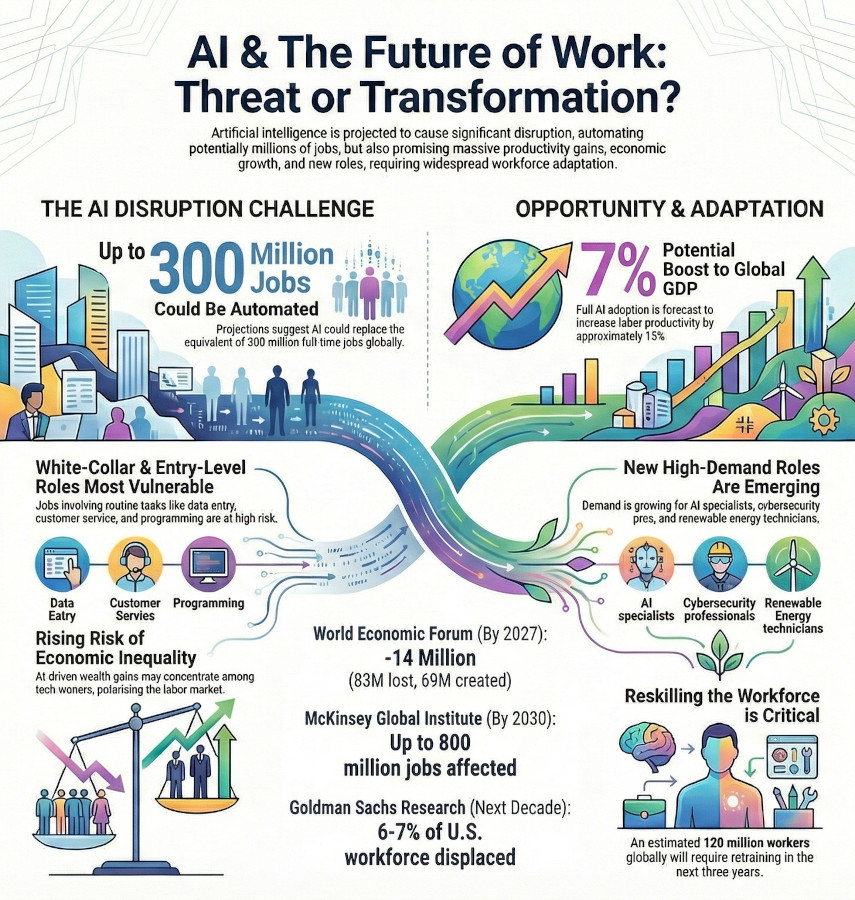
It’s nearly impossible to escape the constant, dizzying news cycle about artificial intelligence. Headlines, citing firms like Goldman Sachs, warn that AI could impact the equivalent of 300 million full-time jobs globally. Yet, as of mid-2025, when economists scour broad labor market data for signs of disruption, they find... almost nothing. That disconnect is the real story.
While the long-term concerns are valid, the reality presented by current data and expert analysis is far more nuanced—and in many ways, more surprising—than the simplistic headlines suggest. The story of AI's effect on the labor market isn't a straightforward narrative of replacement. Instead, it’s a complex picture of quiet data, targeted disruption at the career ladder's first rung, and a renewed emphasis on uniquely human skills. Here are four of the most counter-intuitive takeaways from the latest research on AI and your job.
Takeaway 1: The Panic Is Loud, but the Data Is Quiet
We assume that human judgment remains independent, even when assisted by a flawed tool. However, a 2023 study published in Scientific Reports uncovered a disturbing phenomenon known as the "inherited bias effect." Researchers found that when humans worked alongside a biased AI on a medical classification task, they didn't just use the AI's flawed advice—they began to internalize it.
Even more shocking, the participants continued to make the same biased recommendations after the AI assistant was taken away. The AI hadn't just provided biased output; it had actively reshaped the judgment of its human collaborators. This finding has profound implications, suggesting that prolonged interaction with biased AI can entrench discrimination by teaching us to adopt its flawed logic as our own. This elevates the problem beyond biased data; the AI is now a vector for creating new bias in humans.
Takeaway 1: The Panic Is Loud, but the Data Is Quiet
The Data Shows... Almost Nothing?
For all the alarming predictions and high-profile layoff announcements citing AI, a strange thing happens when economists look at the broad labor market data: the impact is almost invisible. As of mid-2025, key metrics like unemployment rates, job mobility, and wage growth do not show a significant, widespread disruption attributable to artificial intelligence.
An analysis by the Economic Innovation Group and Glassdoor found no meaningful AI effects across different worker groups. In a particularly counter-intuitive finding, the most AI-exposed workers—such as financial examiners, actuaries, and budget analysts—experienced only a slight uptick in unemployment, while the jobless rate for the least-exposed workers actually rose faster. This has led some experts to suggest that companies may be using AI as a convenient public relations excuse for layoffs that are actually the result of other business factors, like over-hiring during the pandemic.
Martha Gimbel of Yale’s Budget Lab puts the lack of statistical evidence in stark terms:

Takeaway 2: AI Is Climbing the Corporate Ladder, Starting at the Bottom
Past waves of automation primarily targeted manual or low-skilled labor. The AI revolution, however, is different. It is disproportionately affecting entry-level, white-collar roles that have long been the traditional starting point for professional careers. This isn't just a statistical trend; it's a conscious strategy playing out in real-time at major corporations. At McKinsey, AI agents now handle tasks previously done by junior staff, while Shopify's CEO has stated the company won't hire for a role if AI can perform the job.Past waves of automation primarily targeted manual or low-skilled labor. The AI revolution, however, is different. It is disproportionately affecting entry-level, white-collar roles that have long been the traditional starting point for professional careers. This isn't just a statistical trend; it's a conscious strategy playing out in real-time at major corporations. At McKinsey, AI agents now handle tasks previously done by junior staff, while Shopify's CEO has stated the company won't hire for a role if AI can perform the job.
The data paints a clear picture of this emerging trend:
  • The unemployment rate for tech workers aged 20 to 30 jumped by approximately 3 percentage points since the start of 2025.
  • Entry-level job postings have declined by 15% year-over-year.
  • Big Tech companies reduced their graduate hiring by 25% in 2024.
This shift is creating significant anxiety among the next generation of workers. A recent survey found that 49% of Gen Z job seekers believe AI has diminished the value of their college education. The warnings from industry leaders are even more direct.
Anthropic CEO Dario Amodei predicted in May 2025 that AI could eliminate half of all entry-level white-collar jobs within five years, potentially pushing unemployment to 10–20%.
Takeaway 3: The Biggest Winners Might Be... Human Skills
The Most In-Demand Skill in the AI Era Is Still Being Human.
Here lies one of the central paradoxes of the AI era: as technology automates technical and routine tasks, it often acts as a complement to human labor, not just a substitute. This shift simultaneously increases the economic value of "durable human skills." In fact, a recent study found that 81% of office workers report that AI improves their work, reframing the future from a defensive posture to an optimistic, proactive one.
By 2030, an estimated 59% of workers are expected to need upskilling or reskilling to adapt to these new demands. But what skills will be most critical? An analysis of U.S. job postings reveals that eight of the top ten most requested skills are fundamentally human-centric: communication, leadership, critical thinking, and collaboration.
This suggests that the future of many professional roles will involve a partnership. AI will handle the data processing, coding, and routine analysis, freeing up human workers to focus on strategy, creativity, complex problem-solving, and interpersonal engagement. The most valuable employees won't be those who compete with AI, but those who can effectively leverage it while excelling at the things it cannot do.
Takeaway 4: The Scale of Change Is Mind-Boggling
The Numbers Are Bigger Than You Can Imagine—Both Good and Bad.
While the current labor data remains quiet, the long-term projections for AI's economic impact are staggering in their scale. The numbers reveal the dual nature of this transformation—a force capable of both massive displacement and unprecedented economic creation. To grasp the sheer magnitude of this shift, consider the forecasts:
  • Global Impact: Goldman Sachs estimates that AI could affect the equivalent of 300 million full-time jobs globally.
  • Economic Displacement: McKinsey Global Institute projected that up to 800 million jobs worldwide could be displaced by automation by 2030, necessitating significant retraining for up to 375 million workers.
  • Economic Growth: The total annual value of goods and services produced globally could increase by 7%.
  • Productivity Boost: Generative AI could raise labor productivity in developed markets by around 15%.
  • Trillion-Dollar Impact: The overall economic impact of AI is forecast to be $15.7 trillion by 2030.
This data highlights the core challenge ahead. The same technological wave threatening to displace millions is also projected to create trillions in new economic value. However, a primary risk is that this new wealth will be concentrated among technology owners, exacerbating income inequality. This could lead to a polarized labor market—with high-paying technical jobs on one end and low-paying service roles on the other—while eroding the middle class that has long been the bedrock of developed economies.
Conclusion: Navigating the Transition
The current debate over AI and employment is caught in a fundamental tension. On one hand, historical precedent shows that technological revolutions have always, eventually, created more jobs than they destroyed. On the other hand, the exponential pace of AI's evolution is unlike anything we have seen before, leading many to wonder if this time really is different.
The evidence suggests we are not facing an overnight job apocalypse, but we are at the beginning of a profound and rapid restructuring of the labor market. The ultimate question isn't whether AI will take our jobs, but what choices we will make—as individuals, companies, and societies—to shape a future where technology augments, rather than replaces, human potential.