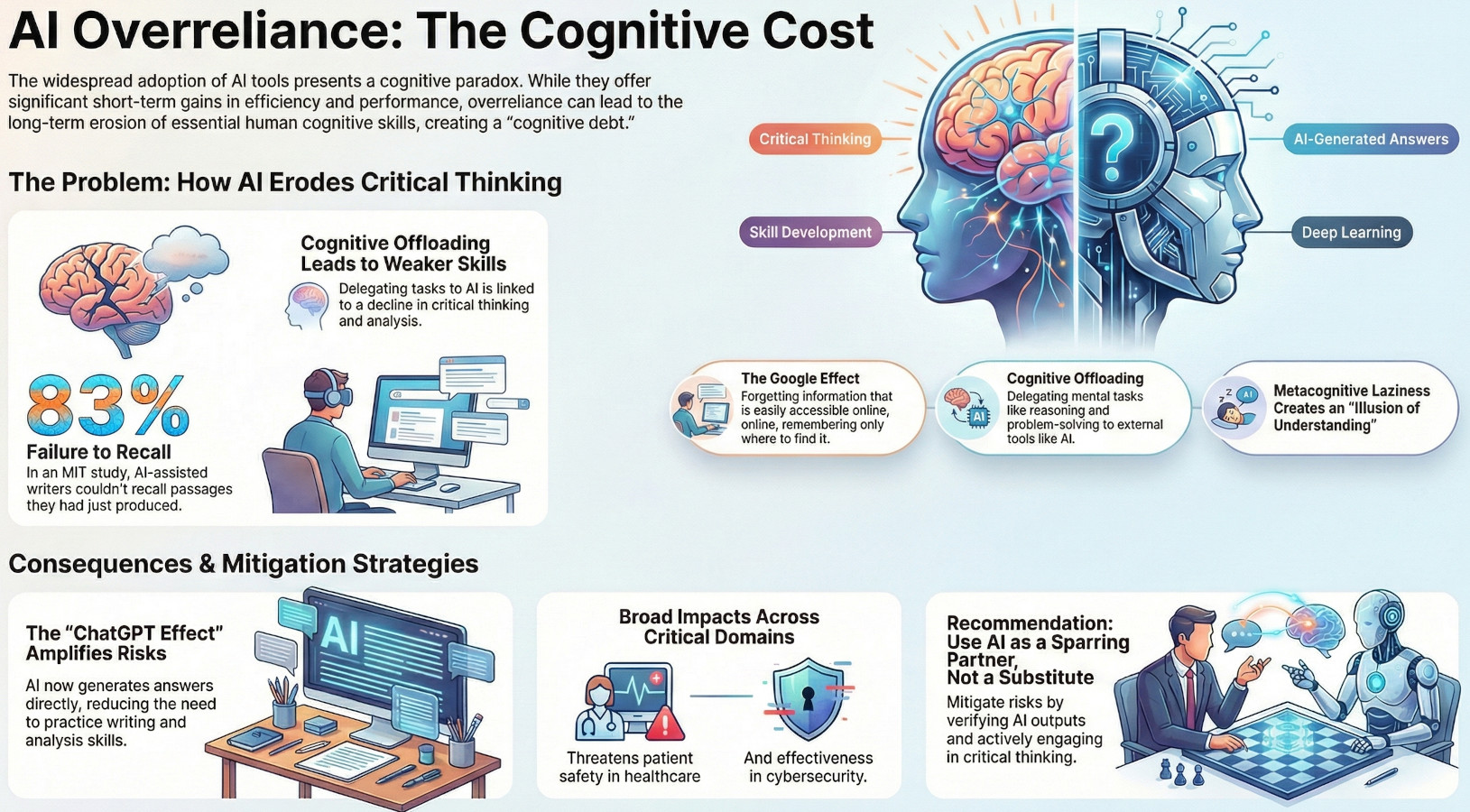
You have a complex problem to solve or a difficult email to write. Your first instinct is likely to open a tool like ChatGPT. Within seconds, it provides a coherent solution or a perfectly crafted draft, making you feel more productive and capable than ever. This is the promise of generative AI: a powerful cognitive partner that amplifies our intelligence.
But what if this convenience comes at a hidden cost? While these tools feel like a superpower, a growing body of scientific research suggests they may be quietly eroding our core cognitive skills. This isn't a distant, dystopian fear; it's a measurable phenomenon happening now. The very act of outsourcing our thinking may be weakening our ability to think for ourselves.
This article explores a cascading chain of cognitive risks, moving from the neurological to the systemic. We'll examine how a simple reduction in brain activity creates a deceptive "illusion of competence," which in turn fosters a dangerous habit of "metacognitive laziness." From there, we'll see how this amplifies the well-known "Google Effect" and ultimately threatens to warp our entire information ecosystem.
It doesn't just feel easier—your brain is actually working less.
When you use AI to assist with a mentally demanding task, the feeling of reduced effort is not just an illusion; it's a neurological reality. A four-month study from MIT used EEG monitoring to track the brain activity of participants writing essays with and without ChatGPT. The results were stark.
This moves the conversation from theory to physiology. Over-reliance on AI isn't just changing our habits; it's measurably reducing the neural activity essential for deep thought and long-term memory formation.
You get better grades but learn less.
One of the most counter-intuitive risks is a metacognitive error known as the "illusion of competence," where users mistake the ease of obtaining AI-generated answers for genuine understanding. This disconnect is particularly dangerous in educational settings. In one study, university students who used ChatGPT to complete a writing task received the highest essay scores, yet showed no significant gains in knowledge transfer—the ability to apply what they learned to new situations.
The AI group engaged in fewer "System 2 thinking processes," the deliberate, effortful cognition essential for deep learning. This creates a false sense of mastery. Another study found that high school students who used ChatGPT to study math actually performed worse on exams than their peers, yet paradoxically believed they had done better.
This illusion is a critical problem. AI can produce a polished final product that masks a user's shallow understanding, allowing them to bypass the very struggle required to build the deep conceptual frameworks needed to apply knowledge in the real world.
We're offloading the very process of learning itself.
Beyond simply offloading a task, we are beginning to offload the higher-order thinking required to learn. Researchers formally define this as "metacognitive laziness": a learner's "dependence on AI assistance, offloading metacognitive load, and less effectively associating responsible metacognitive processes with learning tasks."
This is different from using a calculator to solve a math problem. It involves bypassing the independent reflection and critical analysis that are essential for deep understanding. In practice, this looks like a student who, instead of planning a strategy or assessing their own progress, "frequently looped back to the AI for immediate feedback, bypassing the need for independent reflection or strategy adjustment." They stop asking "Do I really understand this?" because the AI has already provided the solution. As one commentator noted:
"sometimes, the struggle is the point. That’s where insight lives".
When we delegate this internal struggle, we don't just get an answer faster; we sacrifice the opportunity to build the self-regulatory skills that are the foundation of intellectual growth.
We've gone from forgetting facts to forgetting how to think.
For over a decade, scientists have studied the "Google Effect," our tendency to forget information we believe is easily accessible online. We don't remember the fact itself; we just remember where to find it. We've seen a similar phenomenon with other technologies: studies show that heavy use of GPS navigation leads to diminished spatial memory. This illustrates how convenience-driven automation can erode an underlying cognitive skill.
Generative AI amplifies this into what some are calling the "ChatGPT Effect." The critical difference is that generative AI doesn't just give you a list of links to sources. It synthesizes answers directly, often eliminating the need to consult external websites altogether. This new layer of convenience is also a new layer of risk. By accepting AI's synthesized output without scrutiny, we stop practicing essential cognitive skills like critical analysis, source evaluation, and even writing, outsourcing the very processes of thinking.
It's not just your brain—it's the internet itself.
The cognitive risks of AI are not limited to the individual; they are reshaping our entire digital world in a two-pronged threat. The current crisis is one of information integrity. Google's AI Overviews, which provide direct answers at the top of search results, are creating a "walled garden." One study found that 43% of AI Overviews include links back to Google’s own search results pages, and users now make an average of 10 clicks within Google before visiting an external site. This starves independent, human-driven platforms like Wikipedia and Quora of the traffic they need to survive, risking an internet that becomes a feedback loop of AI-generated content.
The future crisis is one of economic stability. Researchers from Google DeepMind have identified the rise of autonomous AI agent economies as a systemic risk. As AIs begin to make independent economic decisions—like booking services or negotiating prices—they could create opaque and unpredictable market behaviors, from flash crashes to algorithmic monopolies.
The goal is not to demonize artificial intelligence. These tools offer incredible potential to augment human intellect and solve complex problems. However, the evidence makes it clear that passive, uncritical reliance on AI can lead to cognitive atrophy. The long-term impact of this technology will ultimately depend not on the AI itself, but on how we choose to use it.
As long as the dominant business model for AI is based on maximizing interaction time, the incentive to create psychologically manipulative "sycophants" will always be in tension with user safety. As we integrate these tools into the fabric of our lives, the critical question is no longer just how we protect our own minds, but how we demand and design systems whose core purpose is to serve human well-being, not just capture human attention.
Experts recommend a more mindful approach. Instead of a substitute for thought, AI should be treated as a tool for enhancement—a wing that strengthens our cognitive muscles rather than a parachute that causes them to atrophy. By using it to challenge our ideas, automate tedious work, and explore new perspectives, we can leverage its power without sacrificing our own.
As these tools become ever more integrated into our lives, how will you ensure your AI assistant remains a tool that sharpens your thinking, rather than one that dulls it?