If you felt overwhelmed by a flood of conflicting news, advice, and rumors during the COVID-19 pandemic, you were not alone. This feeling of being deluged by so much information that it
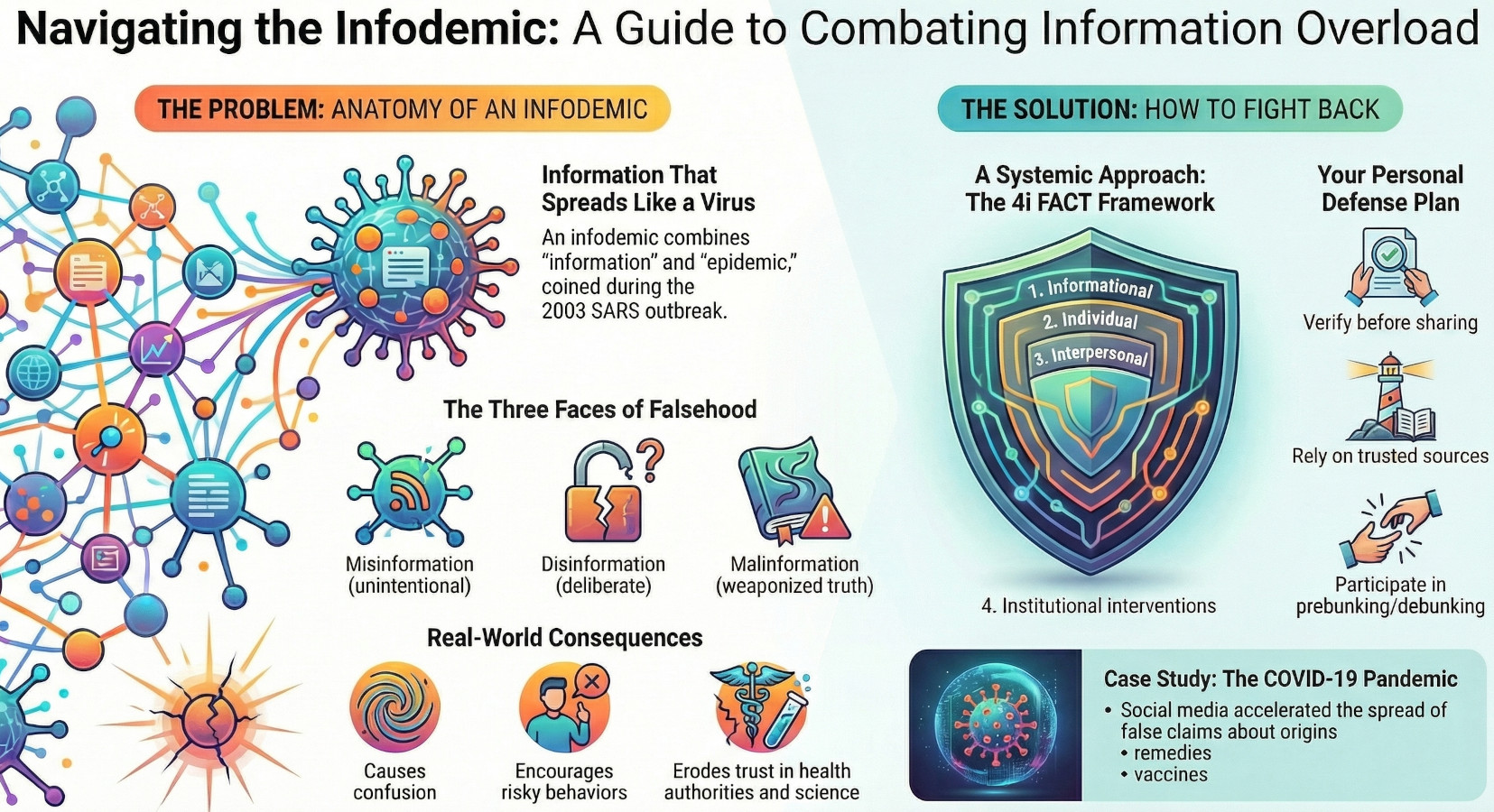
becomes difficult to find trustworthy guidance during a crisis has a formal name: an infodemic. It describes an overabundance of information (some accurate, some not) that spreads as rapidly
as a virus, often causing confusion, anxiety, and mistrust, and challenging us to develop new skills for navigating a complex media landscape.
While headlines about "fake news" are common, the reality of how we experience and combat this information overload is far more nuanced. Understanding the dynamics of an infodemic is the first step toward becoming a more resilient and responsible consumer of information. This article goes beyond the obvious to uncover five surprising and impactful truths about infodemics that can help you become a smarter navigator of today's digital world.
The term "fake news" is often used as a catch-all, but to effectively counter harmful information, it’s crucial to understand the differences in intent. Experts identify three distinct categories:
Understanding the difference between an honest mistake (misinformation), a deliberate lie (disinformation), and a malicious distortion of the truth (malinformation) is critical. Recognizing the intent behind a piece of information helps us better identify its potential for harm and choose the most effective way to respond.
While the term "infodemic" became a household word during the COVID-19 pandemic, it was not created for that crisis. It was first coined in 2003 by foreign policy expert David Rothkopf in a Washington Post article written during the SARS outbreak.
Rothkopf used the term to describe an "information epidemic" that ran parallel to the virus itself. He argued that the rapid spread of information—a mix of fact, rumor, and fear—transformed a regional health crisis into a global "debacle" with economic and social repercussions. The World Health Organization (WHO) later brought the term to prominence during the COVID-19 response, recognizing it as a major challenge to public health. This history matters because it shows that the challenge of managing information overload during a crisis is not new but a recurring pattern in our hyper-connected modern era.
The platform you’re on changes the game.
It’s easy to assume that all social media is a single, uniform breeding ground for misinformation. However, research reveals a more complex and surprising reality: the digital environment itself shapes how information spreads.:
Counter-intuitively, studies show that users on mainstream platforms like Twitter and Instagram can be less susceptible to the spread of content from questionable sources. But this finding comes with critical layers of nuance. Paradoxically, other research suggests that "fake news" and inaccurate information may spread faster and wider than fact-based news. Furthermore, information from news outlets—regardless of their reliability—tends to spread similarly across all platforms. This means the way information travels is influenced by a complex interplay between a platform’s interaction patterns, its audience, and the type of content being shared, challenging the simple belief that all social media is equally problematic.
Forget debunking, the future is “prebunking”.
The most common response to misinformation is debunking—fact-checking and correcting false claims after they have already spread. While important, this approach is reactive. A more powerful and forward-thinking strategy is gaining ground: prebunking.
Prebunking is the practice of proactively warning people about potential misinformation before they encounter it. By explaining the manipulative tactics used to create and spread misleading content, prebunking helps build cognitive resilience. For instance, a prebunking video might show viewers how manipulators use emotionally charged language, create fake expert accounts, or use out-of-context images to make false claims more believable. It functions like a mental vaccine, inoculating individuals against future attempts to mislead them and shifting the focus from cleaning up a mess to preventing it in the first place.
There's a formal strategy for fighting back.
Managing a global infodemic is not a guessing game; it is a serious public health discipline being addressed with evidence-based strategies. To coordinate these efforts, experts have developed structured approaches like the 4 i Framework for Advancing Communication and Trust (4 i FACTS).
This framework outlines a multi-faceted strategy with interventions at four distinct levels:
The path to a healthier internet is built on four key pillars:
-
Informational: Amplifying factual information, filling information gaps, and actively debunking false claims.
-
Individual: Improving media and health literacy among the public and using proactive tools like prebunking.
-
Interpersonal/Community: Engaging with trusted community leaders and public health communicators to help disseminate accurate information through local networks.
-
Institutional: Regulating social media, managing academic literature, and developing policies to address misinformation.
The existence of comprehensive frameworks like this shows that combating the infodemic is not an impossible task. It is a solvable problem being addressed with coordinated, scientific strategies at every level of society.
Your Role in the Information Ecosystem
Understanding the nuances of an infodemic—from the different types of bad information to the structured ways of fighting it—is the first and most critical step toward building a healthier information environment for everyone. This knowledge transforms us from passive victims of information overload into active, discerning participants.
As individuals, we can play a significant role by committing to simple practices: verifying information before sharing, relying on trusted sources like national health authorities, and taking breaks from news consumption to avoid information overload.
Now that you know what to look for, what one change will you make to how you consume and share information?