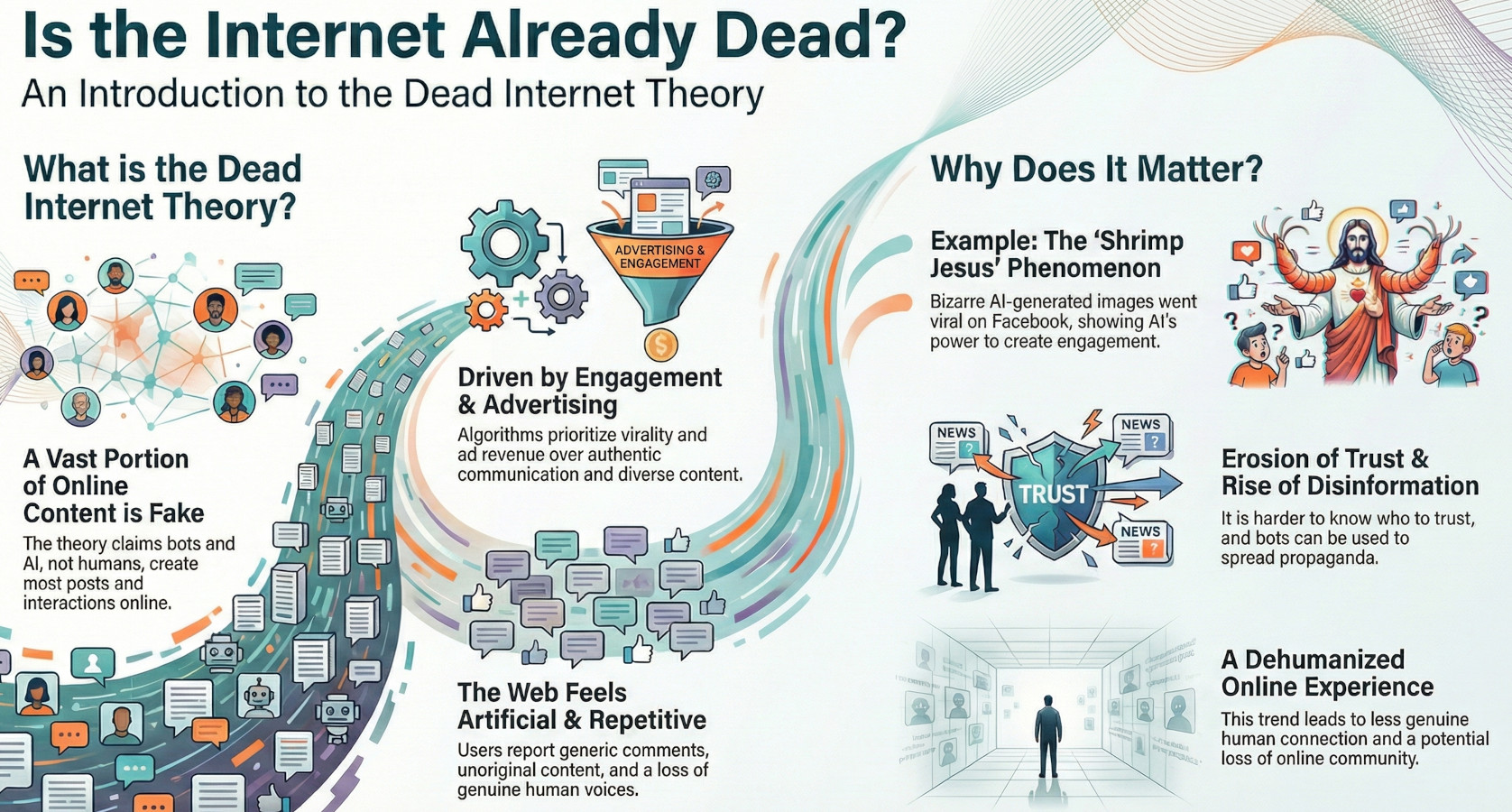
Have you ever scrolled through a social media feed and had the uncanny feeling that you’ve seen it all before? The same comments, the same jokes, the same outrage, all echoing in a digital chamber that feels increasingly artificial. This sense of repetition and homogenization isn't just in your head; it’s a shared experience that has given rise to a fascinating and unsettling concept.
This concept is the "Dead Internet Theory" (DIT). It first began circulating on forums like 4chan and Reddit before gaining mainstream attention in 2021 with a post titled "Dead Internet Theory: Most of the Internet is Fake" on Agora Road's Macintosh Café. The theory's core idea is that a vast and growing portion of our digital world is no longer driven by genuine human activity. Instead, it posits that our feeds—from posts and comments to likes and shares—are now dominated by sophisticated bots and artificial intelligence designed to mimic human behavior.
This theory challenges our fundamental assumptions about what it means to be online, suggesting the web is becoming a space populated more by programs than by people. This post will explore the five most impactful takeaways from this theory, examining the evidence, the drivers, and the profound implications of a potentially "dead" internet.
The central premise of the Dead Internet Theory is that a massive portion of the content we engage with daily is not created by people. It suggests that the posts we read, the comments we see, and the likes that validate them are increasingly generated by sophisticated bots and AI. This activity is designed to create a convincing illusion of a bustling, human-centered digital world, a trend accelerated by the recent explosion of large language models (LLMs) like ChatGPT.
Proponents of the theory describe the feeling as being akin to walking into a crowded room, only to realize most of the people there are mannequins programmed to react in predictable ways. This is the most profound impact of the theory: it forces us to question our core assumption that when we are online, we are connecting with other humans. If we are mostly interacting with machines, the very nature of online discourse, community, and connection is thrown into question.
While it’s easy to imagine a "dead internet" as the work of malicious actors, the theory argues that its primary driver is far more mundane: profit. The shift towards an automated, less human web is a direct consequence of the internet's dominant business model. As big tech companies grew, advertising became their financial engine, which led to a relentless drive to optimize for engagement above all else.
This corporate agenda created the perfect environment for bots and AI to thrive. Sophisticated bots were developed to inflate engagement numbers, push specific products, and create the appearance of widespread activity. In this model, artificial engagement is often more profitable and scalable than genuine human interaction. This focus on scalable, predictable engagement is what directly contributes to the "homogenization of online spaces," creating the repetitive and artificial feeling that first gave rise to the theory.
3. The Evidence is Weirder Than You Think
The consequences of this profit-driven, engagement-obsessed ecosystem aren't just theoretical; they manifest in bizarre and obvious ways across major platforms. These moments reveal the sheer scale of non-human activity and the strange, homogenized content it produces.
A prime example is the "Shrimp Jesus" phenomenon. On Facebook, bizarre, AI-generated images combining Jesus Christ with crustaceans received thousands of likes and comments, illustrating how nonsensical AI-generated images can attract thousands of likes and comments from automated bot accounts, creating a feedback loop of pure artificiality that requires no human involvement. Other obvious signs include the rise of entirely AI-generated influencers who have real followings and the widespread use of bots to manipulate social media metrics and create the illusion of popularity or consensus.
4. The Real Cost is Our Connection
Beyond the proliferation of fake content, the theory's most significant concern is the deeper, more corrosive impact on human experience. The true threat is the "erosion of trust," the "loss of content diversity," and the overall "dehumanization of the internet experience." When we can no longer distinguish between human and bot interactions, our ability to trust the information we see and the "people" we talk to degrades.
A core tenet of the theory's proponents is this powerful idea:
The Dead Internet Theory is not just about false information; it is also about the lack of human connection.
This is the critical point. If we are increasingly interacting with machines designed to hold our attention for profit, the internet ceases to be a place for community and discourse. This could fundamentally affect everything from our personal relationships and mental health to the integrity of democratic processes, which rely on authentic public conversation.
5. A Warning Shot, Not a Wild Conspiracy
It is important to acknowledge the critiques of the Dead Internet Theory. Some argue that it is an "overstatement," pointing out that humans still create the majority of content and conversation on major platforms. Others dismiss it more forcefully as a "conspiracy theory, fueled by misinformation and sensationalism."
It is important to acknowledge the critiques of the Dead Internet Theory. Some argue that it is an "overstatement," pointing out that humans still create the majority of content and conversation on major platforms. Others dismiss it more forcefully as a "conspiracy theory, fueled by misinformation and sensationalism."
Conclusion: Where Do We Go From Here?
Whether the internet is technically "dead" or simply unwell, the Dead Internet Theory highlights a genuine and deeply concerning trend. Our online world is becoming increasingly artificial and less human, driven by algorithms and corporate agendas rather than authentic interaction. But the theory's most chilling implication may be its potential to become a self-fulfilling prophecy. As our online spaces feel more artificial and we become more skeptical, our own genuine participation may decline, leaving an even larger void for AI to fill.
The next time you're online, ask yourself: is this a genuine community, or am I just witnessing a performance staged by algorithms?