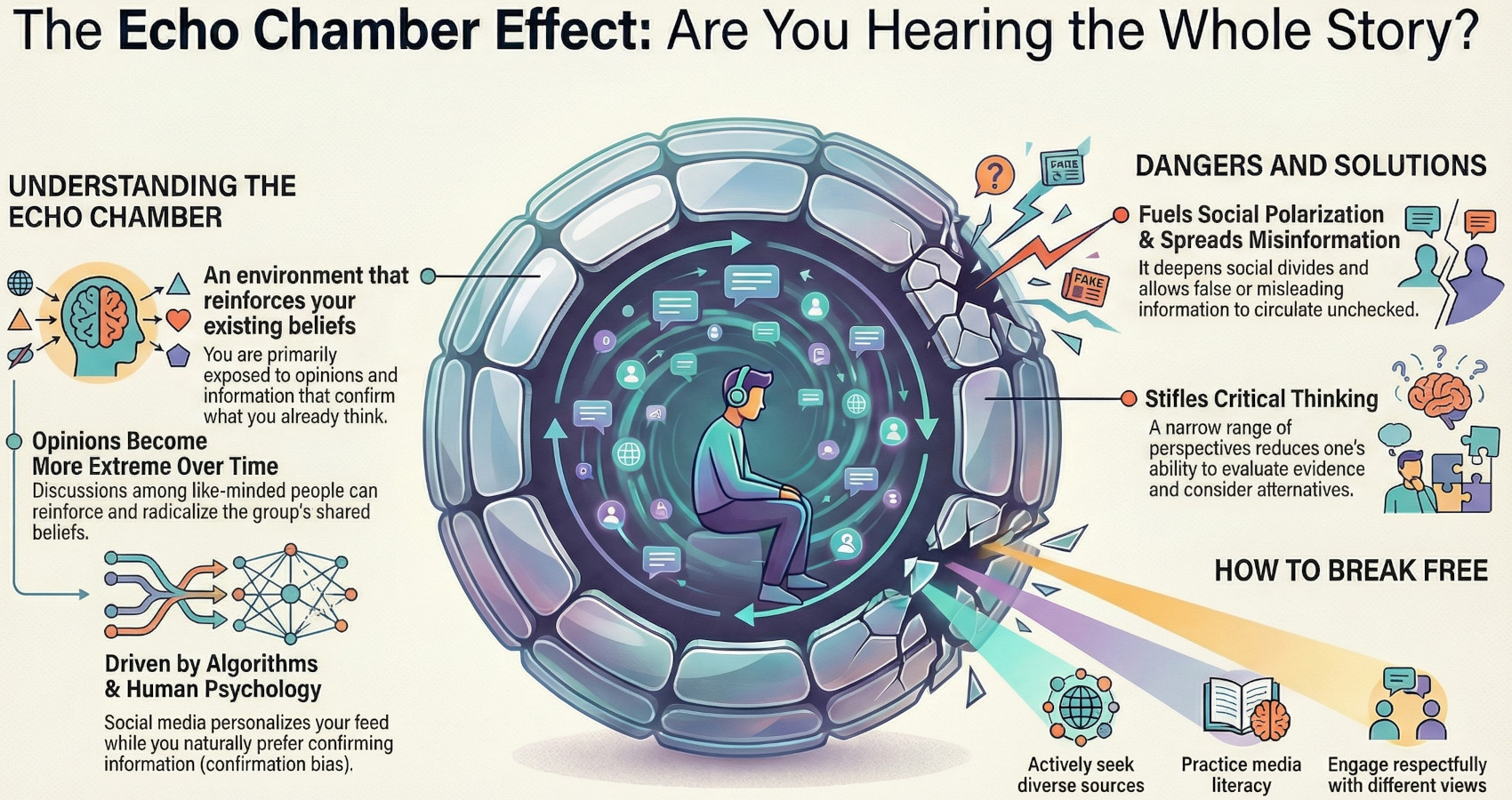
If you’ve spent any time on the internet recently, you’ve likely noticed the digital landscape feels more polarized and divided than ever. Conversations quickly devolve into arguments, and it often seems like people are living in completely different realities. A key factor driving this division is the "echo chamber," an environment where we are mainly exposed to information and opinions that reinforce what we already believe. While research suggests these bubbles may not be as inescapable as commonly believed, their psychological impact on those within them is profound and escalating.
While it’s easy to blame social media algorithms for trapping us in these bubbles, that’s only half the story. The truth is far more complex and personal. The architecture of these digital spaces is powerful precisely because it exploits deep-seated psychological tendencies we all share. This article explores the surprising and impactful ways echo chambers operate on our minds, going beyond the algorithm to reveal the cognitive biases and emotional triggers that make them so effective.
The most powerful force keeping echo chambers intact isn't a line of code; it's human nature. Technology certainly amplifies the effect, but these chambers are fueled by our own cognitive wiring. We are predisposed to seek out information that confirms our existing beliefs, a tendency psychologists call "Selective Exposure" or "Confirmation Bias." We instinctively gravitate toward content that makes us feel right, as it avoids the cognitive dissonance—the mental discomfort—that comes from being challenged.
This natural bias is supercharged by "Homophily," our tendency to associate with like-minded people. Online, this creates "closed information loops" where our social networks are composed almost entirely of people who think and believe as we do. This behavior is reinforced by social validation; likes, shares, and positive comments act as rewards, creating a dopamine feedback loop that trains us to stay within the group’s accepted norms. Realizing this is crucial because while algorithms curate our feeds, it is our own behavior that provides the data powering their decisions. We are active participants in the construction of our own information bubbles.
Once our biases draw us into these like-minded groups, a more dangerous process begins. Echo chambers don’t just keep our beliefs stable; they actively make them more extreme. This is the perfect incubator for "Group Polarization," a phenomenon where discussions among like-minded individuals cause their collective opinions to become more extreme over time.
The mechanism is simple but powerful: as individuals in a group share and validate one another's views without encountering counterarguments, their confidence grows. This mutual reinforcement leads to what the research calls "a radicalization of beliefs and a heightened sense of certainty." What may have started as a moderate opinion can, through repeated reinforcement within the chamber, escalate into an unshakable and extreme conviction. This is a profoundly counter-intuitive point. The echo chamber acts as an accelerator, actively pushing groups further toward the ideological fringes and making common ground harder to find.
3. They Can Hijack Your Emotions
This radicalization of belief is then supercharged by a powerful, subconscious force: "Emotional Contagion." This is a process where the emotional tone of the content we consume directly influences our own emotional state. If your feed is dominated by angry, fearful, or outraged posts from your in-group, you are more likely to feel angry, fearful, or outraged yourself.
This emotional reinforcement is a powerful adhesive, making us more entrenched in our beliefs and more resistant to information from outside the chamber. When a belief is tied to a strong emotion, challenging that belief feels like a personal attack. Facts and data from an opposing viewpoint become irrelevant because the issue is no longer about logic—it's about identity and feeling. The impact of emotional contagion shows that echo chambers manipulate us on a subconscious level, short-circuiting our rational thought processes and locking us into a cycle of emotional and ideological reinforcement.
4. The Societal Stakes Are Terrifyingly High
The consequences of these psychological mechanisms extend far beyond online arguments. When entire segments of the population are sealed off in separate informational realities, the real-world effects can be severe. Key consequences identified by researchers include "Increased Polarization," the "Spread of Misinformation," "Reduced Critical Thinking," which stifles our ability to evaluate evidence, and widespread "Social Fragmentation."
These aren't abstract academic concepts; they are tangible threats to the fabric of society. The lack of shared facts erodes trust in institutions, paralyzes democratic processes, and isolates communities from one another. As one analysis starkly warns, the problem has reached a critical stage:
"One of my greatest concerns is echo chambers. It was nothing short of an ontological shock when I became aware of just how widespread this is. The sheer hatred, low tolerance and disrespectful conduct online is largely due to echo chambers. If we do not wake up to the aforementioned, I fear the worst. Unthinkable acts by people are more frequent, violent and unless this is addressed society is a ticking time bomb. If it explodes nothing but anarchy will ensue."
This potent observation makes it clear that the problem of echo chambers is not just about online incivility. It is a genuine and escalating threat to social cohesion and the foundational principles of a functioning, democratic society.
Conclusion: Is There a Way Out?
The true danger of online echo chambers lies in their insidious ability to exploit our natural psychology, polarize our beliefs into extremes, and manipulate our emotions. By understanding these underlying mechanisms, we can begin to see the bars of our own cognitive cages.
The walls of our echo chambers are built by algorithms but reinforced by our own minds—which opposing viewpoint will you consciously seek out and try to understand today?