That Sinking Feeling of a Worsening Web
It’s a universal feeling in the modern digital world: the creeping realization that the apps and platforms you once loved are actively getting worse. The social media feed that once connected you with friends is now a cluttered wall of ads and algorithm-pushed content. The online store where you could find anything now buries the best products under a mountain of sponsored listings.
This post breaks down the four key takeaways of "enshittification," revealing that this decline is not accidental, but a deliberate and profitable playbook.
It’s a Predictable Three-Stage Cycle
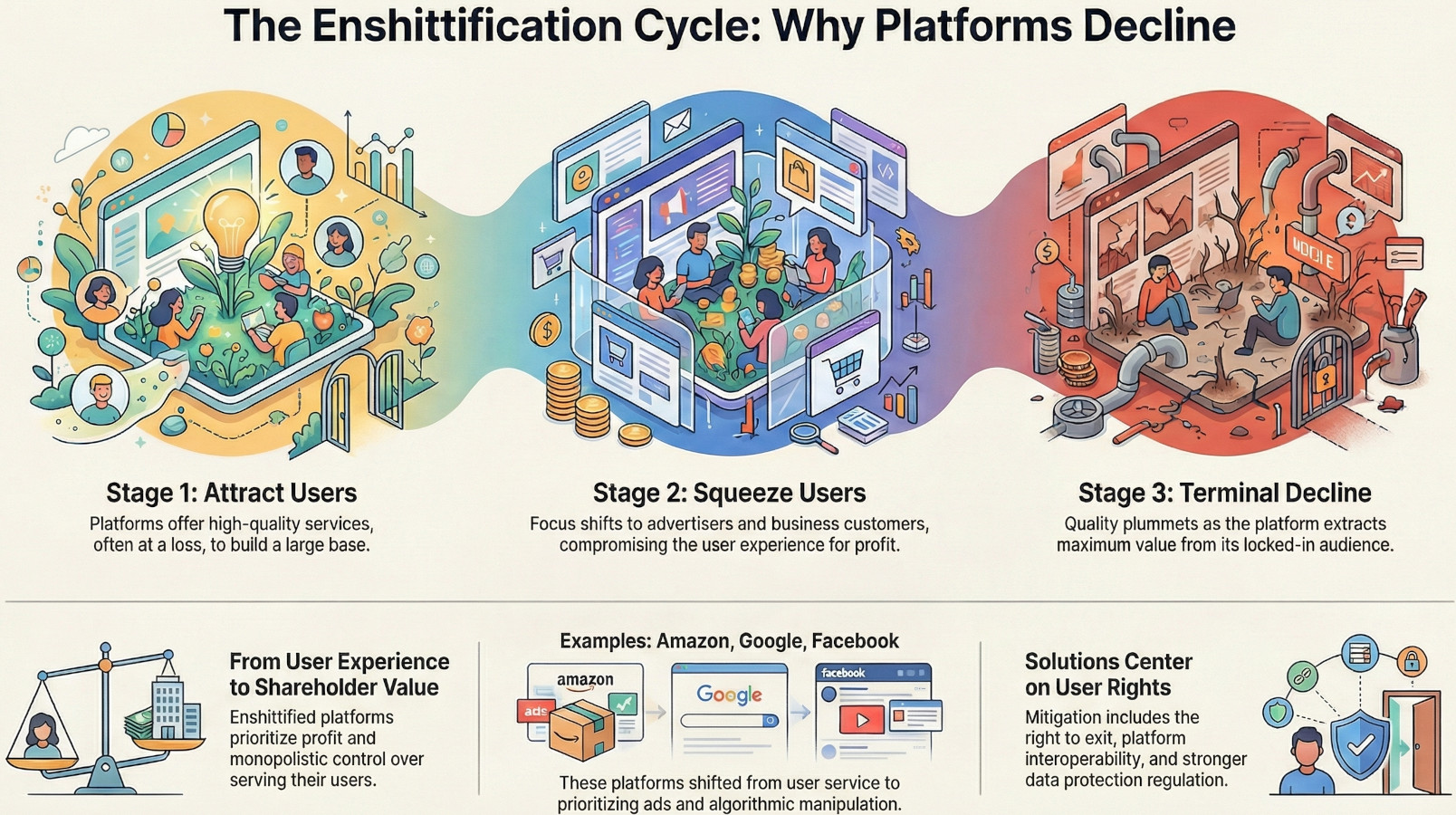
Enshittification isn't random decay; it's a structured process that unfolds in three distinct stages, designed to capture and then exploit both users and businesses.
The cycle begins with Initial Quality. To attract a large and loyal user base, platforms start by offering a fantastic experience, often at a financial loss. They prioritize growth above all, making their service easy, valuable, and enjoyable to use.
But this initial quality is a means to an end. Once a critical mass of users is achieved and a "lock-in" effect takes hold—making it difficult to leave—the platform's incentives pivot sharply. This initiates the second stage: the Abuse of Users. The priority shifts from serving users to serving business customers, like advertisers. The user experience is deliberately compromised with more ads, sponsored content, and algorithmic feeds that benefit the platform's bottom line, not the user.
Finally, the platform enters Terminal Decline. In this end stage, the platform exploits everyone—both its users and its business customers—to squeeze out all remaining value. Quality degrades severely as the platform has no incentive to improve. This manifests as search results on a shopping site prioritizing paid listings over the most relevant items, frustrating both shoppers and honest sellers alike.
This process is captured in a single, core definition:
Enshittification refers to the gradual degradation of online platforms, such as social media, search engines, and e-commerce sites, from high-quality services to low-quality, profit-driven entities.
It's Not a Bug, It’s the Business Model
At its core, enshittification isn't a technical glitch; it's the intended outcome of a business model that relentlessly prioritizes shareholder value over user experience. This predictable decay isn't a flaw in the system; it is the system.
This three-stage cycle isn't inevitable—it's a product of a specific environment. When monopolistic control eliminates meaningful competition, platforms are emboldened to abuse users in stage two without fear of a mass exodus. This environment, characterized by a lack of interoperability and an increased reliance on advertising, creates the perfect conditions for the cycle to run its course. We see this playbook in action across the digital world, from Facebook's pivot to data collection and Google's degradation of search results to Amazon's prioritization of profits over customers.
This Isn't New - It's a Modern Take on an Old Problem
While the term "enshittification" is recent, the concept behind it has deep roots in economic theory. It's a modern application of older, well-understood behaviors like planned obsolescence and monopolistic rent-seeking, simply repurposed for the digital age. Just as a manufacturer might design a physical product to fail after a few years, a digital platform is architected to degrade its user experience once it has achieved market dominance.
The term's real value lies in its ability to cut through jargon and connect the frustration an everyday user feels with established academic concepts like surveillance capitalism. It provides a blunt, memorable name for a pattern, bridging the gap between simply noticing a platform's decline and grasping the deliberate business logic that causes it. And because these are known monopolistic behaviors, we also have established regulatory and competitive frameworks to counter them.
We're Not Powerless - There Are Ways to Push Back
Understanding this cycle isn't just about diagnosing the problem; it also points toward a cure. The fight against this trend hinges on core principles designed to restore power to users and reintroduce healthy competition into the digital marketplace.
The path to a healthier internet is built on four key pillars:
-
Upholding the end-to-end principle, which ensures data is transmitted directly between users and services without interference.
-
Guaranteeing users the "right of exit," allowing them to leave a platform and take all of their data and social connections with them without loss.
-
Promoting interoperability, creating a framework where different platforms can connect, which fosters competition and gives users real alternatives.
-
Using regulation to prioritize user rights and data protection, shifting the balance of power from platforms back to the people who use them.
A Real Pro Will Probably Start Over Anyway
Here is a consequence most people never consider: if you eventually hire a professional to fix a system set up by an amateur, they will likely discard all the previous work. Many certified IT professionals adopt a "Zero Trust approach" when encountering a system configured by an unqualified person.
This means they will treat the situation as "a new setup" rather than attempting to repair the undocumented, ad-hoc changes. The reason is simple: a professional cannot vouch for the integrity of work that isn't properly documented. The lack of a clear, auditable history makes the system an unacceptable risk. For you, this means the time and effort spent with your friend was not a head start; it was a liability. The professional must rebuild from a secure foundation, which can increase the project's scope and final cost.
Enshittification is not a series of isolated incidents; it is the predictable playbook of a business model that now dominates the web, one that values extraction over user satisfaction.
Understanding this concept is a form of empowerment. It transforms you from a frustrated user into an informed observer who can identify the cycle as it happens and see the deliberate choices behind the decline of the digital tools you use.
Now that you can see the pattern, how does it change the way you view the digital tools you use every day?