Why Your Friend's 'Quick IT Fix' Could Be Your Biggest Tech Mistake
The primary issue with a friend's advice isn't their intention; it's a matter of cognitive bias and perspective. We often ask friends for help because of a natural "tendency to model behavior." We see their ad-hoc solutions appear to work for them, so we assume their approach is effective, even when it isn’t based on expert knowledge. Their advice is a reflection of their history, not a true analysis of your unique needs.
This anecdotal approach is the polar opposite of a qualified expert’s diagnostic process. A professional is trained to "analyze complex issues objectively," distinguishing symptoms from the root cause. Crucially, true expertise is specialized. Even within IT, a professional who excels at hardware may not have the skills to secure your system from cyber threats. The core problem is asking an unqualified person for help when what you need is certified, specialized expertise for a specific challenge.
The "Quick Fix" Creates Long-Term Costs
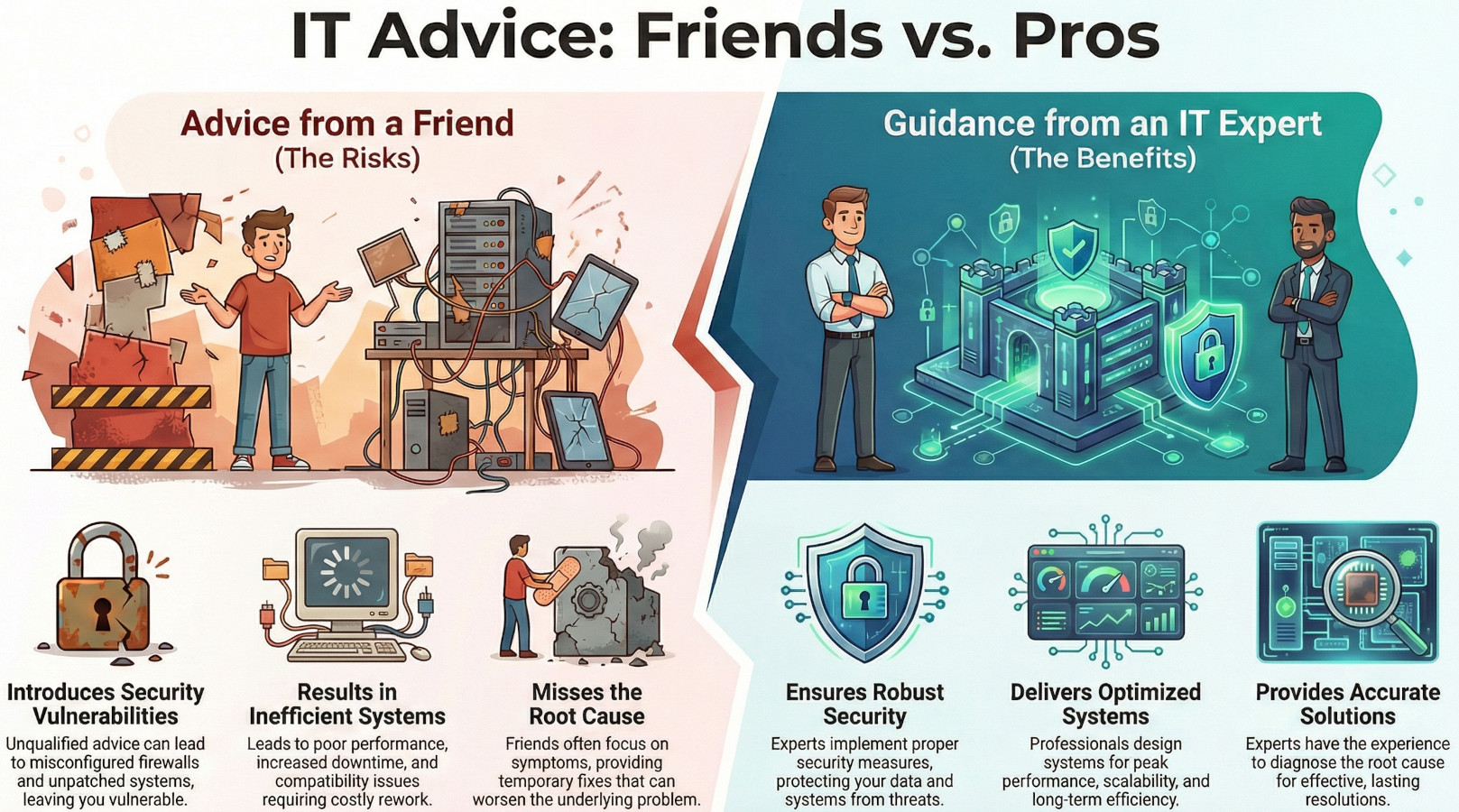
The attempt to save money by avoiding a professional often backfires, creating a form of technical debt that accrues interest over time. Amateur solutions frequently "require rework" or "introduce new problems," turning a small issue into a major liability. A well-meaning but misguided fix can lead to "suboptimal system configurations," resulting in reduced performance and compatibility issues that hamstring you for years.
These temporary patches often become permanent flaws, leading to "increased maintenance costs" as you continually prop up a fragile foundation. Worse, you may discover the system your friend built isn't scalable, forcing a complete overhaul when it's time to grow. A qualified IT expert acts as a strategic partner, providing guidance that prevents these roadblocks and identifies opportunities. The irony is that avoiding a small professional fee today often means paying a much larger one tomorrow to untangle the mess.
2. Platforms Are Designed to Get Worse: It's Called "Enshittification"
Of all the risks, this is the most critical. Unqualified IT advice can introduce severe security vulnerabilities, leaving your personal or organizational data exposed. Without a deep understanding of security protocols, a friend can accidentally create gaping holes in your digital defenses while trying to get something to "just work."
These risks are not theoretical. They manifest in common but critical errors, including:
- Misconfigured firewalls
- Unpatched vulnerabilities
- Compromised passwords
These mistakes leave your systems and data "vulnerable to attacks." Your friend might get a program running, but remain completely unaware that they disabled a critical security feature in the process. In their effort to solve one problem, they have essentially left the digital door unlocked for anyone to walk through.
A Real Pro Will Probably Start Over Anyway
Here is a consequence most people never consider: if you eventually hire a professional to fix a system set up by an amateur, they will likely discard all the previous work. Many certified IT professionals adopt a "Zero Trust approach" when encountering a system configured by an unqualified person.
This means they will treat the situation as "a new setup" rather than attempting to repair the undocumented, ad-hoc changes. The reason is simple: a professional cannot vouch for the integrity of work that isn't properly documented. The lack of a clear, auditable history makes the system an unacceptable risk. For you, this means the time and effort spent with your friend was not a head start; it was a liability. The professional must rebuild from a secure foundation, which can increase the project's scope and final cost.
Conclusion: Treat Your IT Like Your Health
While we trust our friends, their well-meaning IT advice can lead to unforeseen costs, glaring security holes, and strategic dead ends. The convenience of a quick favor is rarely worth the long-term risk of an insecure, inefficient, and undocumented system.
Ultimately, the decision requires treating your technology with the same seriousness as your health. The comparison is more nuanced than you might think.
You would not seek medical help from your friend who is not a Medical Doctor... The same holds true for Information Technology.
Even beyond that, just as some doctors excel at diagnostics but might not know the most current treatment regimen, an IT generalist is not a cybersecurity specialist. Seeking the right expertise is paramount.
When building your digital foundation, the most strategic question isn't "how do I fix this now?" but "who can I trust to build this for the future?"