From a digital anthropology perspective, we can view the internet not as a space, but as a system governed by forces akin to physics. Its vast, interconnected nature—its inherent complexity—is precisely what creates "entropy," a state of disorder, unpredictability, and chaos. This manifests as the overwhelming flood of content and the rapid, uncontrollable spread of misinformation. This chaos isn't a bug; it's a fundamental property of a complex social system.
To manage this, platforms introduce a different, intentional kind of complexity: structured frameworks and algorithms. These systems are designed to mitigate the natural entropy by curating content, prioritizing interactions, and creating a more organized, predictable environment. The dynamic isn't a simple battle of order versus chaos. Rather, it's a constant process of managing complexity with more complexity, where platforms impose their own architectural order on the system's natural state. This battle to impose order on chaos is not just a technical challenge; it has profound political implications, leading directly to our next point.
2. Censorship Isn't Just for Authoritarian Regimes
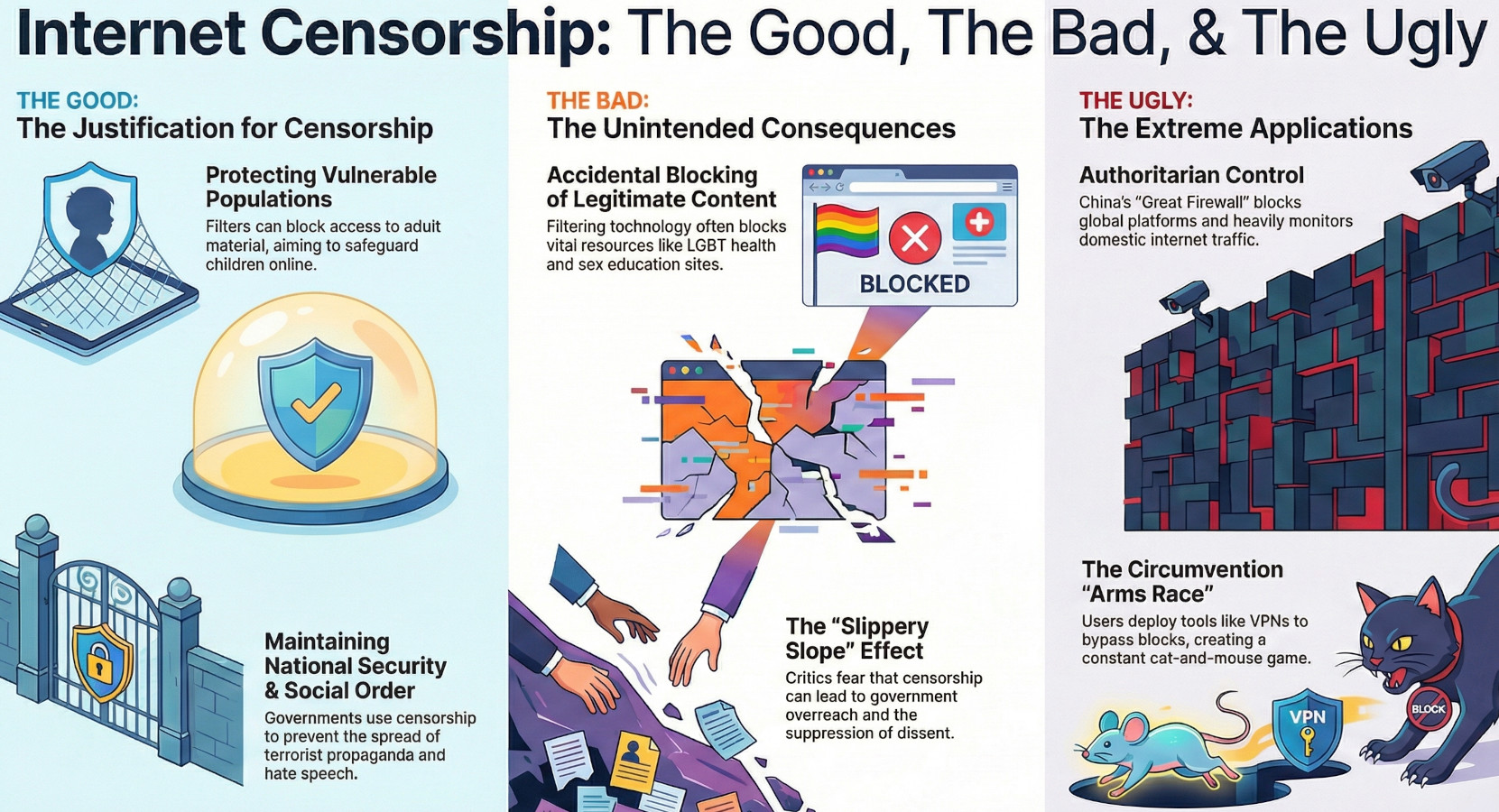
It's a common misconception that aggressive internet censorship is a tool used exclusively by authoritarian states. The reality is that a growing trend of aggressive censorship is present even in democratic nations, often justified by national security. The threat is made clear in the surprising example of Norway, a country renowned for high internet freedom. Network measurements there found potential blocking of content ranging from human rights websites and online dating sites to digital petitions and calls for protests.
This demonstrates that censorship is a latent threat in every digital society. More insidiously, this trend creates a "chilling effect" on free expression, where individuals begin to self-censor their views out of fear of repercussions, even if their content is never directly blocked. The psychological impact of potential surveillance can be as powerful as any firewall. These subtle forms of control are often embedded in the very architecture of the platforms we use.
3. A Platform's Design Directly Regulates Your Creativity
Beyond algorithms, the very design of a user interface has a measurable impact on our behavior. Research reveals a counter-intuitive finding: an "inverse U-shaped relationship" exists between an interface's complexity and a user's creativity. As an interface gets more complex, users become more creative and thoughtful in what they share—but only up to a tipping point. After that, too much complexity causes creativity and disclosure to suffer significantly.
Furthermore, as interface complexity rises, users tend to refer less to themselves and exhibit less breadth in their information sharing. The ethical implication here is profound: platform architects are, in essence, becoming unwitting (or witting) regulators of human expression, capable of dialing creativity up or down through subtle design choices we barely notice. This power to shape behavior through design also manifests in tools created for more explicit forms of control.
Are You Playing, or Are You Being Played?
While platforms claim these filtering tools are used to combat spam and abuse, the architecture of the system itself produces manipulative effects, even without conscious intent. This lack of transparency creates a system where public opinion can be shaped, and polarization can be amplified, as an emergent property of algorithmic governance.
Gamification is an undeniably powerful psychological tool. It can be a force for good, motivating us to learn, stay fit, and engage more deeply with our communities. But this same power can be used to foster addiction, manipulate behavior, and serve hidden agendas. The growing awareness of these dynamics is a crucial form of digital literacy.
The distinction between ethical and unethical gamification lies in its answer to a single question: who benefits most? As these systems become more integrated into our lives, the responsibility falls on us to critically evaluate their purpose. The next time an app prompts you to keep a streak alive, ask yourself: am I being empowered, or am I being engineered?