Every day, we navigate a hidden architecture of influence. We chase likes on social media, maintain streaks on fitness apps, and collect badges on learning platforms. These features feel like harmless fun, designed to make the mundane more engaging. With each notification and point scored, we feel a small thrill of accomplishment, guided by what seems like our own volition.
This article pulls back the curtain on the gamified world we inhabit, revealing three truths about how these systems work. It explores an escalating progression: from how a simple reward can unintentionally destroy genuine passion, to how fun is deliberately engineered into compulsion, and finally, to where the line is crossed from a helpful nudge into outright manipulation.
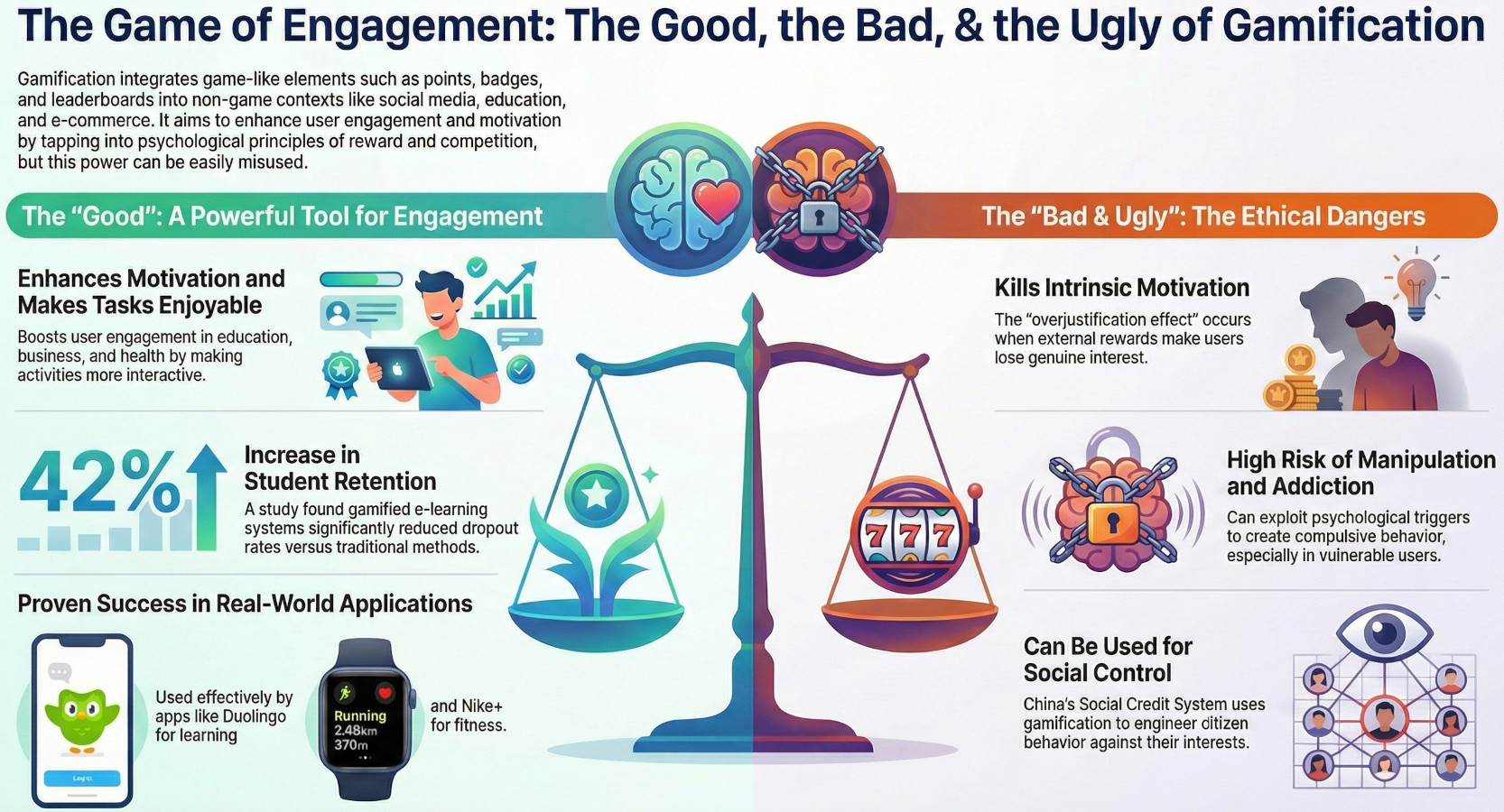
It’s a foundational assumption: if you want to encourage a behavior, reward it. But this logic hides a psychological paradox known as the "overjustification effect." This phenomenon occurs when an external reward—like points, money, or a prize—decreases a person's intrinsic motivation for an activity they once performed simply for the enjoyment of it.
This effect was first demonstrated in a 1971 study by researcher Edward Deci, where subjects who genuinely enjoyed solving puzzles showed less interest after being paid to do so. The external reward had corrupted their internal drive. The reason for this is rooted in self-determination theory, which posits that humans have a fundamental need for autonomy. When an external reward is introduced, it can undermine our sense of control, shifting the reason for doing something from an internal desire ("I want to") to an external obligation ("I have to").
Consider a person who paints for the sheer pleasure of creating art. Once they start selling their work, the focus can shift from personal enjoyment to financial gain, and the original passion that fueled them can diminish. This suggests a fundamental paradox for platform designers: the very tools used to boost short-term engagement may be corroding the long-term, authentic interest that creates lasting value.
2. The Designed Addiction Loop
When this psychological principle is understood, it can be deliberately engineered to create habits. Many gamified systems are designed to be addictive by triggering dopamine releases in the brain when users achieve milestones, creating a feedback loop that encourages repetition. This reward cycle can lead to compulsive behavior, where users feel compelled to engage with a system even when it interferes with their daily lives.
Think of Snapchat streaks or daily login bonuses. These features are not just about rewarding loyalty; they are about manufacturing psychological obligation. The fear of breaking a streak or missing a badge can transform a voluntary action into a source of anxiety. Once these compulsive habits are formed, the door opens for more overt forms of manipulation, where the user's engagement is no longer the goal, but a tool for organizational gain.
From an ethical standpoint, this is deeply concerning as it preys upon the underdeveloped impulse control of vulnerable populations, such as children and adolescents. The mechanics that guide a fitness app toward encouraging a healthy walk are the same ones that can foster digital addiction, raising a critical question: where is the line between designing for positive engagement and designing for compulsion?
3. The Hidden Agendas Behind the Points
Here we arrive at the "ugly" side of gamification, where the primary concern is not user benefit but organizational gain, often achieved through manipulation. This can lead to what researcher Tae Wan Kim terms "bullshitification"—a situation where users become so enamoured with game elements like points and leaderboards that they lose sight of the underlying objectives they were meant to achieve. On the Salesforce Trailhead learning platform, for instance, users have become more focused on collecting badges than on the actual learning the badges represent.
The core of this ethical problem is a lack of transparency. When users are unaware of the true intentions behind a gamified system, they are being manipulated. As gamification pioneer Yu-kai Chou states:
"...gamification is completely unethical when there is a hidden agenda that users are not aware of, such as when users think they are signing up for something but end up with something else."
Perhaps the most extreme real-world example of this is China's Social Credit System. This state-run system assigns scores to citizens to socially engineer their behavior, using the mechanics of gamification not for user benefit, but for state control. People are routinely having their freedoms and privileges to basic necessities taken away for having low social credit scores, a stark reminder of how these game-like systems can be used to coerce and control.
Are You Playing, or Are You Being Played?
While platforms claim these filtering tools are used to combat spam and abuse, the architecture of the system itself produces manipulative effects, even without conscious intent. This lack of transparency creates a system where public opinion can be shaped, and polarization can be amplified, as an emergent property of algorithmic governance.
Gamification is an undeniably powerful psychological tool. It can be a force for good, motivating us to learn, stay fit, and engage more deeply with our communities. But this same power can be used to foster addiction, manipulate behavior, and serve hidden agendas. The growing awareness of these dynamics is a crucial form of digital literacy.
The distinction between ethical and unethical gamification lies in its answer to a single question: who benefits most? As these systems become more integrated into our lives, the responsibility falls on us to critically evaluate their purpose. The next time an app prompts you to keep a streak alive, ask yourself: am I being empowered, or am I being engineered?